
2026
By: Alexander Holmes
Having a conversation about difficulty in game design shouldn't be this hard.
Yet, and tell me if you feel this way too, the Difficulty Discourse doesn't seem to have evolved or changed at all for more than a decade. Ever since Dark Souls got popular a couple years after its release in 2010, the gaming zeitgeist has repeated this conversation every time a souls-like game, a fromsoftware game, or a souls-like metroidvania game has released to popular acclaim. And, quite frankly, everyone, including you and me, are tired of having the same conversation about it.
And I'm going to tell you why it's so tiring. First, because there is no ideological debate in the first place. Second, because the very existence of the difficulty discourse makes me and you, yes even you, physically unable to have a novel thought about game design as it relates to difficulty.
Part 1: There is no Winner; Therefore, There is No Debate.
First, let's settle the idea that there even is an ideological debate about video game difficulty. There is not. And the reason there is not is because all the conversations about difficulty, difficulty modes, adaptive difficulty, and whether it is good or bad. are not mutually exclusive.
Right now I am displaying on screen the same 9 talking points that get repeated in the difficulty discourse every year.
Artistic Intent is important, so developers shouldn't have to make difficulty modes
There's no “Right Way” to play, I can play the game how I want.
Unified Social Experience: I like that everyone shares the same experience as me
Online Multiplayer Balancing means it would be harder to integrate people of different difficulties
Difficulty Modes Are Accessibility Features
Wanting as many people to enjoy the game as possible
Limited Developer Time/Resources means some developers can't make difficulty modes
Single Difficulty Mode Varies the Difficulty based on Player Skill
Social Clout: Hard games prove to others how much more skilled I am.
Now I'm going to blow your mind with what I'm about to say.
Literally none of these points are mutually exclusive. They can all exist simultaneously, and a single person can, simultaneously, believe every one of these contentions is true and important.
For a moment, imagine with me some characters you may encounter in real life, but may be hard to find on the internet.
First, I want you to meet Terry. Terry is a person who believes in the artistic intent of a game developer, one who envisioned that there was a correct way to play the game to have the best possible experience. While at the same time Terry is also someone who recognizes that players may choose to play in whatever manner they wish, even if it clashes with the intended experience, and he likes that freedom of experience that video games can provide too. Terry Two Type, he represents two types of players who do seemingly opposite things with their play.
Second, I want you to meet Sam. Sam is a person who believes that these high difficulty games are best when everyone has a shared experience of what the game is, and that difficulty modes may detract from that same experience, while also wanting as many people as possible to enjoy the game without unnecessary exclusion. Sam thinks that balancing a cooperative multiplayer environment can make game design more challenging on developers, while also understanding that difficulty modes are an accessibility feature for people with different life circumstances. Or even just helpful for players who are new to a certain genre of game. Sam thinks those life circumstances, those differences external to the video game, means some people have a harder or easier experience with the game than others, and therefore not having difficulty modes may also detract from the desire for everyone being able to have that same experience of difficulty. They are Every Man Sam, and they just want everyone to be able to form a sense of community around a thing they love.
Third, Dana. Dana is a person who believes that the creation of difficulty modes requires time and resources from developers, and yet still want higher difficulty modes so that she may demonstrate her gaming skill by having rare trophies listed on her STEAM store profiles, and yet feel no sense of pride nor clout if a game that is widely recognized as difficult by the gaming public did not deliver for her personally the experience of struggle and overcoming that makes it feel earned. Dana is a high-skill player who has purchased multiple collectors editions, plays these games for years, and creates her own challenge modes just to feel that feeling of accomplishment again. Someone who never stops playing the games in the years between releases. Thus going off to reddit and bluesky to make posts that say, “Silksong wasn't even that hard actually.” She is Daring Dana, and she represents the highest end of the core audience who feels like she isn’t being catered to, because she’s just that good at video games.
The kicker is that these are not strict archetypes. You do not have to be a Terry Two Type, an Every Man Sam, nor a Daring Dana, and you will probably be all of them at different times. All of those same beliefs and feelings can exist in a single individual without any presence of self-contradiction nor irrationality. We call that feeling Ambivalency. The Germanic prefix Ambi-, meaning “Both.” And the Latin verb Valēre, meaning “to be strong.” Ambivalency is the feeling of multiple ideas being strong in your mind, even if they sometimes create friction with the other strongly held beliefs. And yet the presence of one idea does not deny nor disprove the validity of the others.
The only thing that changes from person to person is how much they care about any of these specific values. Someone may think that they are all extremely important but should only be expressed in different contexts. Someone else may think all of them are important and should be taken into consideration in all contexts. And others may think some of these values aren't important at all, and become very rude on the internet when they feel the values they do consider important are being diminished.
Only you can decide which kind of person to be online, but the fact remains that none of these values are going to disappear, no matter how many games are made that prioritize them differently.
The problem is not that we have to fight to protect these values so that they have a place in the world. In my opinion, the problem is that always having the same arguments about these values means that no new ideas can be created from these conversations. New ideas that could inspire future games you haven't even dreamt, if only a conversation about how these values may be translated into software and gameplay could start happening again.
Let me show you what I mean.
Part 2: Difficulty Discourse Rots Your Brain
So the animus to this second video about Silksong, wherein i’m using Silksong footage and thumbnail for the meta-data but never actually talk about the game, is because my first video about Silksong was about how gameplay design motivated the player to disengage from the corpse-run system. Thereby making the corpse-run system irrelevant for some, or actively encouraging some players to disengage from the core gameplay of Exploration, Platforming and Combat. To instead farm for the resources to avoid losing them on a corpse-run. Or when doggedly refusing to explore somewhere else if they left any rosary beads behind.
This was a pretty successful video for me. At the time of taking the data, Of the 467 votes the video got, 422 are likes and only 45 are dislikes.
That video received 223 comments. Of which 12 are my replies to other people to remove from the sample size. The adjusted total is 216. And finally, the last limitation to my data collections, is that youtube’s creator dashboard back-end truncates lengthy comments with a “read more” button, and re-truncates the comments after I clicked Ctrl+A, Ctrl+C, Ctrl+V to get them into my documents for data collection.
Some of these comments are quite heated. For example I was accused of being a liar for saying that a runback to a souls bonfire can be made 100% safe. I stand by that statement, but that doesn’t mean people won’t find a way to not do it safely. Little things like that. But no one called me a slur or anything. Overall pretty civil, but rest assured I still muted any bigots I saw to the comments that weren’t directed at me.
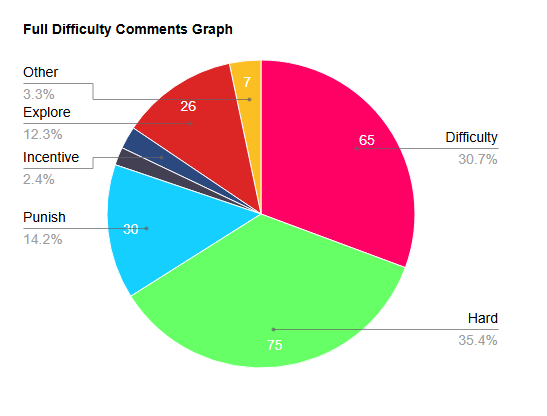
Here I am displaying on screen a few pie charts of the number of comments received by topic, after I exclude my own comments to viewers.
Comments that use the word “difficulty” : 65
Comments that use the word “Hard” : 75
Comments that use the word “Punish” : 30
Comments that referenced the “Corpse Run” system : 4
Comments that use the word “Motive or Motivation” to discuss player motivation : 0
Comments that use the word “Incentive” to discuss player motivation : 5
Comments that use the word “Explore” alluding to the system being related to player motivation: 26
As you can see, Difficulty and things being hard or not completely dominated the conversation. Despite my efforts to present the concept of resource distribution with the term Punishing as distinct from the concept of difficulty, so that I could better explore player motivations without that baggage. The difficulty, or lack there of, was the majority of topics. Either for obtaining enough Rosaries beads to make purchases being not that hard, or if they found backtracking to be not as hard, or if they thought farming for rosaries was not that hard. Or if they thought collecting the shell shards was hard or not hard… so on and so forth. Even as the specific wording changed with various comments, it was clear that any comments that weren’t simple expressions of thanks for the video or silly jokes were about difficulty and nothing else.
4 of the 216 initiated a conversation about corpse-run systems; 5 of the 216 comments talk about player motivation. The field was barren of what i was hoping to motivate. I was trying to start a conversation about how to make a corpse run system something that stays meaningful in gameplay, rather than something the player stops caring about once they have overcome the in-game economy.
I had exactly one comment express that they didn’t agree with the argument that the corpse-run tells players to go explore. Rather, if a person is engaging with it, then it motivates not exploring by returning to the same place as before. That the decision to go explore is the decision to give up on engaging with the corpse run system. I also had one comment argue that giving up on the corpse-run system also counts as engaging with the corpse-run system; that is a person I would like to work for, so that when I don’t do any work I can tell them that not working my job is a form of working at my job.
I had exactly one comment relating the hoarding of Rosaries as part of the game’s narrative theming on questioning tithing and indulgences by the church, which I do honestly appreciate. But I find that theming somewhat lacking if it is tied to a system that the player is ultimately motivated to disengage from to better focus on the combat loop.
The only interesting dynamic I saw discussed about the corpse-run system wasn’t in my comments but in the videos of fellow youtubers, who talked about how they would sometimes choose to save collecting their silk-coccoon for later in a fight for the combat benefit of getting their silk and hp back quickly later on. Which is a genuinely interesting way to use the corpse-run benefit proactively. But one that I think also supports my original point about the rosary beads. The resources of health and silk are far more valuable and of immediate concern, to the point that optimizing combat involves proactively not caring about the risk of losing your rosary beads.
Now, here's the kicker. I want to give you the statistics of how often I used the words difficult and hard in that video.
In that video, I use the word Difficulty a grand total of 1 time.
I use the word easy or easier 0 times.
I use the word hard 1 time.
I use the word punishing a total of 1 time.
And perhaps this is a failure of my writing, but I attempt as best I could to explain that the concept of Punishing was different than the concept of difficulty. That it was about what happens in the event of a mistake. I attempted to give context to my discussion of backtracking as “not easier” because of the constant exposure to punishing hazards. Which prompted correction from commenters who focused only on how it was just the Easy enemies that respawn, and not the difficult ones. Which doesn't matter too much to my argument, as we were still dealing with 2-Pip damage on contact with enemies and stage hazards. The difficulty didn't matter to me, because the game’s punishing resource design was a far more interesting dynamic to understand than the difficulty of controls or combat.
Yet, as you can see from the data, even a miniscule mention, a miniscule amount of success of a video surrounding games like this, end up sparking a conversation that makes no progress and has no nuance. Barely a mention of a topic only tangentially related to whether or not a game is hard, and we repeat these same 9 talking points ad nauseum.
Not only do these talking points make it so that we can't have other conversations about game design. They also make it so that we can't have NEW conversations about difficulty.
Conclusion:
As of the release of this video, we are more than 15 years out from the releases of Demon’s Souls and Dark Souls. Counter to the predominant narratives of the 2000s, difficult games never went anywhere. They just weren’t the primary concern of the prior three AAA gaming trends - The Sony-styled prestige Adventure Game, the first person shooter adventure campaign, and the mascot platformer game. But if you were playing character action games, bullet hell games, survival and horror games, games that weren’t trying to appeal to the broad idea of the average “core” gamer in that same time, that shit was still hard. The difficulty discourse decided for itself that a core gamer is the person who wants to play a soulslike title, but we never were.
The core gamer is someone who buys one of the annual military shooters, or one of the annual sports games each year, and plays only that game until the next year. The core gamer is a woman in their mid-20s to mid-30s playing some form of mobile game on their phone, who goes through seasons of whether they are playing that game or surfing instagram or tiktok squeezed into their free time between keeping work and home. The core gamer is a family with one or two kids, who purchases whatever the new Nintendo is at Christmas, and lets their kids play Fortnite and Roblox for 300 hours a year. A gamer who likes and plays soulslikes is its own demographic with little overlap when compared to the whole of the gaming market. Gaming enthusiasts, adults with their own income who have been playing games long enough to develop a taste for a certain genre, are the audience for games like Metroidvanias and Soulslikes. This is still a niche interest when compared to the average numbers of how people find entertainment with video games. The difficulty discourse didn’t make soulslikes come into existence. Nor does it serve any function to promote or protect these specific design sensibilities.
What does promote the games are lore videos becoming a genre of youtube, streamers having funny reaction-compilations, critical acclaim among games journalism, both those associated with magazines and websites and those independent reviewers called youtubers, and gaming hobbyists who spend money on these games.
Anyone who is a soulslike genre fan can have and hold all 9 of the arguments about video game difficulty simultaneously while changing nothing about the games themselves. I am done with the difficulty discourse. It’s played out.
We are Gaming Enthusiasts, and what I want to see now are conversations about the game’s design. Stretch your imaginations. Stop arguing about whether something is good or bad, easy or hard, and start discussing new ideas for how to achieve the values at the heart of the needless debate. Stop debating as a fanatic, and start thinking enthusiastically.
Thank you for watching.
Take care of yourselves.
And stay true.